-
Home > News & Events > Blog > Plant Nutrition
As modern agriculture places increasing emphasis on fertilizer and resource use efficiency, fertilizer technology is evolving from simply supplying nutrients toward improving the efficiency with which those nutrients are used. In addition to supplying mineral nutrients such as nitrogen, phosphorus, and potassium, an important focus of fertilizer-enhancement research is how to help crops absorb and utilize nutrients more effectively. Yeast metabolites have therefore attracted growing attention as potential fertilizer-enhancing materials.
The yeast metabolites discussed in this article are not strictly defined as pure metabolic products. Rather, they comprise a composite system consisting of yeast metabolites, residual components of the culture medium that have not been fully absorbed by the yeast, and yeast cells that remain after incomplete filtration. This composition provides a broad spectrum of constituents, including organic acids, fulvic acid, amino acids, small peptides, vitamins, polysaccharides, and mineral elements, as well as plant-hormone-related active substances such as jasmonic acid, salicylic acid, abscisic acid, and auxins. Unlike a single compound, their application value does not depend on the action of any one component alone, but on the synergistic effects among multiple active constituents.
In agricultural production, the primary role of fertilizer is to supply crops with essential nutrients such as nitrogen, phosphorus, and potassium. However, applying nutrients to the soil does not necessarily mean that crops can absorb and utilize them efficiently. Therefore, beyond ensuring adequate nutrient supply, promoting nutrient uptake and improving nutrient use efficiency has become an important direction in fertilizer-enhancement research. The focus of yeast metabolites is precisely to improve the process by which crops absorb and utilize nutrients that are already present, rather than simply increasing the nutrient content of the fertilizer.
Mode of Action: Three Synergistic Pathways by Which Yeast Metabolites Enhance Fertilizer Efficiency
The ability of these yeast metabolites to improve nutrient utilization and enhance crop stress tolerance is closely related to the composition of the composite system. Their effects are thought to be mediated primarily through three synergistic pathways.
First, rhizosphere nutrient activation. The fulvic acid and organic acids abundant in the product can lower rhizosphere pH and, through chelation, mobilize immobilized secondary and micronutrients in the soil. They may also facilitate the release of poorly soluble forms of potassium and phosphorus, thereby improving nutrient availability in the rhizosphere.
Second, root growth promotion. Abundant free amino acids (such as aspartic acid and glutamic acid), small peptides, and B vitamins can serve as signaling molecules or metabolic precursors, stimulating root cell division and elongation, increasing root absorptive area and vigor, and directly enhancing the crop's ability to capture and assimilate nitrogen and other nutrients. Plant-hormone-related substances naturally present in the product, such as indole-3-acetic acid (IAA), may also contribute to the regulation of root growth through direct supplementation.
Third, rhizosphere microbial regulation. β-glucans, mannan-oligosaccharides, and residual culture-medium components that have not been fully assimilated may selectively promote the proliferation of beneficial rhizosphere microorganisms and improve the structure of the rhizosphere microbiome. At the same time, they can act as carriers of organic nutrients and provide a nutrient-buffering effect in the soil, helping to reduce the fixation and leaching of readily available nutrients. Under adverse conditions such as low-temperature stress, this pathway may also favor the enrichment of cold-tolerant plant growth-promoting bacteria, thereby enhancing crop stress tolerance.
These three pathways are not independent. Rather, they overlap and reinforce one another, jointly promoting more efficient fertilizer nutrient utilization and healthier crop growth.
Experimental Evidence: How Yeast Metabolites Improve Nutrient Use Efficiency
To systematically evaluate the effects of yeast metabolites on fertilizer nutrient utilization, the R&D team used cultivated spiral pepper F1 as the test crop in a pot experiment. Five substitution levels of yeast metabolites for chemical fertilizer were established (0%, 10%, 20%, 40%, and 55%), while the total nutrient input was kept constant across all treatments to eliminate the confounding effect of nutrients inherently supplied by the yeast metabolites.
Yield Performance: 20% Chemical-Fertilizer Substitution Produced the Best Yield Response
The results showed that, at the same total nutrient input, replacing part of the chemical fertilizer with yeast metabolites significantly increased pepper yield. When the substitution level reached 20%, pepper yield was the highest, increasing by 67% compared with the treatment receiving chemical fertilizer alone, and the difference was statistically significant. As the substitution level increased further, however, yield no longer increased. These findings indicate that replacing 20% of the chemical fertilizer with yeast metabolites was the optimal level for pepper under the conditions of this experiment.
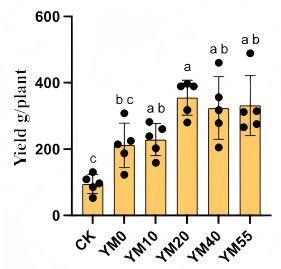
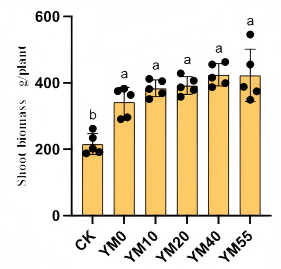
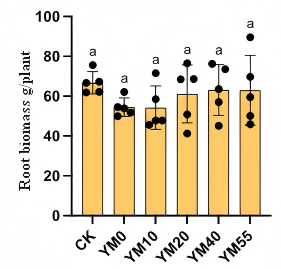
Figure 1. Pepper yield, shoot biomass, and root biomass at different yeast-metabolite substitution levels
Nutrient Use Efficiency: Significant Improvements in Nitrogen and Potassium, but Limited Response in Phosphorus
Yeast metabolites showed clear nutrient-specific responses in terms of fertilizer nutrient use efficiency. Pepper nitrogen use efficiency ranged from 32.22% to 62.70% and increased progressively as the proportion of yeast metabolites increased. When the substitution level exceeded 20%, nitrogen use efficiency was 24–30 percentage points higher than in the chemical-fertilizer-only treatment. Potassium use efficiency also showed a pronounced response, ranging from 42.31% to 77.70%; at a 55% substitution level, potassium use efficiency reached 77.70%. By contrast, phosphorus use efficiency ranged from 17.32% to 24.16%, with no statistically significant differences among treatments, which may be related to the relatively low phosphorus content of the yeast metabolites themselves. Numerically, compared with the treatment without yeast metabolites, nitrogen, phosphorus, and potassium use efficiency increased by 24.62%, 6.53%, and 24.84%, respectively.
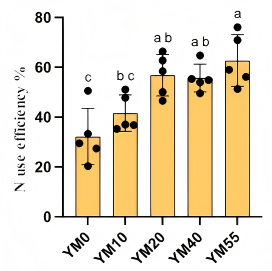
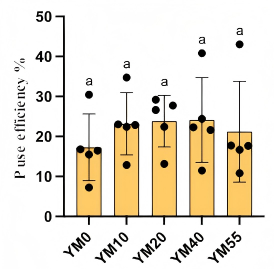
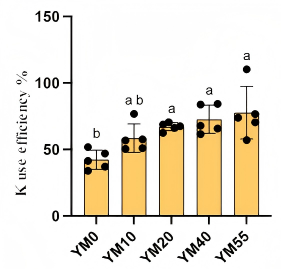
Figure 2. Nitrogen, phosphorus, and potassium use efficiency at different yeast-metabolite substitution levels
Potential for Chemical-Fertilizer Reduction: Reduce Nitrogen by 20%, Potassium by 50%, While Maintaining Full Phosphorus Supply
Under the condition that yeast metabolites replaced 20% of the total nutrient input, the optimal proportions of chemical nitrogen, phosphorus, and potassium fertilizers were further investigated. The results showed that reducing chemical nitrogen fertilizer by 20% had little effect on pepper yield, whereas a 50% reduction resulted in lower yield. Reducing chemical phosphorus fertilizer by 20% already caused a yield decline, and the negative effect became more pronounced as the reduction increased. In contrast, reducing chemical potassium fertilizer by 20%–50% had no significant effect on pepper yield. Based on these results, when yeast metabolites replaced 20% of the total nutrient input, the optimal N:P:K ratio for the remaining chemical fertilizer was 1.41:1.00:1.27. In practical applications, chemical nitrogen can be moderately reduced and chemical potassium can be reduced substantially, while adequate chemical phosphorus should be maintained.
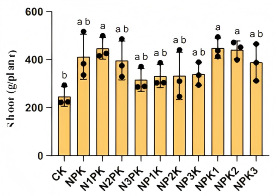
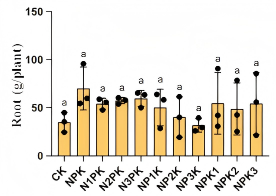
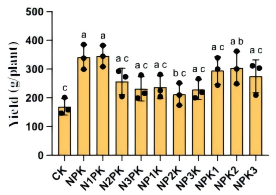
Figure 3. Effects of chemical N, P, K fertilizer ratios on shoot, root, and yield performance after replacing 20% of the total nutrient input with yeast metabolites
Note: N1, N2, and N3 represent 80%, 65%, and 50%, respectively, of the standard chemical nitrogen fertilizer rate; P1, P2, and P3 represent 80%, 65%, and 50%, respectively, of the standard chemical phosphorus fertilizer rate; K1, K2, and K3 represent 80%, 65%, and 50%, respectively, of the standard chemical potassium fertilizer rate.
Low-Temperature Stress Validation: Stability of Fertilizer-Enhancing Effects Under Adverse Conditions
The fertilizer-enhancing effects of yeast metabolites were further validated under low-temperature stress. When more than 20% yeast metabolites were added under low-temperature stress, pepper yield showed no statistically significant difference from the normal-temperature treatment, indicating a substantial improvement in the crop's tolerance to low-temperature stress. At the physiological level, adding 20% yeast metabolites increased root vigor in pepper seedlings by 47.24% compared with the treatment without yeast metabolites, significantly alleviated the low-temperature-induced decline in chlorophyll, and significantly increased POD and SOD activities as well as soluble sugar content. Soluble sugar content increased by 79% relative to the normal-temperature treatment, representing the largest increase among all treatments. In addition, the 20% yeast-metabolite treatment significantly increased vitamin C (VC) and capsaicin contents in pepper, with a clear improvement in quality.
Characteristics of Rhizosphere Microbial Ecology and Root Hormonal Responses
Analysis of the rhizosphere microbial community showed that, under low-temperature stress, adding more than 20% yeast metabolites significantly increased the abundance of Pseudarthrobacter in the pepper rhizosphere, with an increase of up to 88% compared with the lower-substitution treatments. Previous studies have shown that Pseudarthrobacter has strong tolerance to low-temperature stress and can promote plant growth. This may be one of the important reasons why yeast metabolites improve pepper tolerance to low-temperature stress.
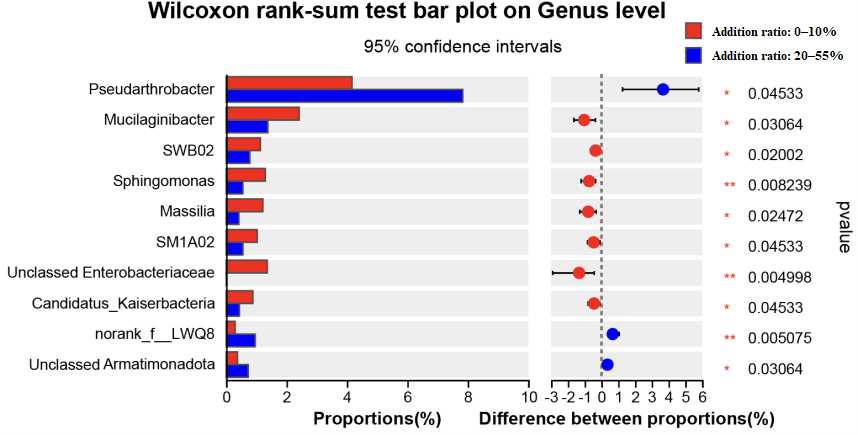
Figure 4. Effects of different yeast-metabolite substitution levels on the composition of the pepper rhizosphere bacterial community under low-temperature stress
In addition to changes in the rhizosphere microbial community, the effects of yeast metabolites on hormones in crop roots also warrant attention. Hormone levels were measured separately in the yeast metabolites themselves and in pepper roots after application. The results showed that the yeast metabolites contained relatively abundant jasmonic acid (JA), salicylic acid (SA), abscisic acid (ABA), and indole-3-acetic acid (IAA), all of which play important roles in plant stress tolerance. In contrast, no clear or consistent pattern was observed in endogenous hormone levels in pepper roots after application. This suggests that the mode of action may rely more on direct supplementation with hormone-related substances present in the product itself than on regulation of endogenous hormone biosynthesis in the crop.
From Experimental Data to Field Application: Translating Results into Fertilizer Programs
Taken together, the experimental results indicate that these yeast metabolites have a clear application logic and considerable potential for practical use.
For fertilizer programs, the results support replacing 20% of the total nutrient input with yeast metabolites. On this basis, chemical nitrogen fertilizer can be reduced by 20%, chemical potassium fertilizer by 20%–50%, while chemical phosphorus fertilizer should be supplied at a full rate. This approach balances yield, nutrient use efficiency, and economic considerations, providing a clear reference for growers.
In terms of application outcomes, the product can contribute to multiple goals simultaneously: improving nitrogen and potassium use efficiency while reducing chemical-fertilizer inputs; enhancing crop tolerance to low-temperature stress and stabilizing yield; improving produce quality and commercial value; and modulating the rhizosphere microbiome to improve the soil environment. These “multiple benefits from a single intervention” reflect the synergistic effects of the multiple components in the system.
In terms of application scenarios, these yeast metabolites can be used in combination with conventional fertilizers for crops such as vegetables, with the application level adjusted according to crop requirements and fertilization practices. Their mode of action does not appear to depend on complex regulation of the crop's endogenous hormones, but rather on direct supplementation with active substances naturally present in the product. This may contribute to relatively stable performance across different crops and environmental conditions.
As research advances into their compositional characteristics, mechanisms of action, and compatibility with different fertilizer systems, the application value of yeast metabolites is expected to become better understood. From yeast fermentation to field application, the agricultural value of microbial metabolic resources is gradually being uncovered. The use of yeast metabolites to enhance fertilizer efficiency not only provides a new technical approach to improving nutrient use efficiency, but also opens new avenues for further research and application of yeast-fermentation products in fertilizer enhancement.
The yeast source organic fertilizer has the advantages of being nutritional, efficient, environmental friendly, soil-improving, etc., and it is suitable for the application of high added value agricultural products, animal husbandry and economic crops. Angel is the founder of yeast source organic fertilizer, and the products all have passed through the EU Organic Certification and China Organic Certification.
About Angel:
Angel Yeast Company is a high-tech listed company specializing in yeast and biotech. Product business covers Yeast and Baking, Yeast Extract-Savoury, Nutrition & Health and Biotechnology fields. It is one of the world's leading companies in the yeast industry. Angel has 12 holding subsidiaries and provides products and services for more than 150 countries and regions.
Press Contact:
ANGEL YEAST CO., LTD
Address: 168 Chengdong Avenue, Yichang, Hubei 443003, P. R.China
Tel& Fax: +86-717-6371118
Email: weiqz@angelyeast.com