Introduction and Product Overview
Mycotoxins are secondary metabolites produced by molds and are widespread contaminants in animal feed and raw materials. Over 100 mycotoxins have been identified to date, with aflatoxin B1 (AFB1), zearalenone (ZEN), fumonisins (FB), deoxynivalenol (DON), and T-2 toxin posing the greatest threats to animal health and productivity [1,2]. It is estimated that approximately 25% of the world’s cereal grains are contaminated with mycotoxins, presenting ongoing challenges to livestock production and food safety.
To mitigate the risks of mycotoxin exposure, four primary strategies are employed: physical detoxification, chemical detoxification, biodegradation, and adsorption detoxification. Among these, the inclusion of mycotoxin adsorbents in feed has become the most widely adopted and commercially viable approach due to its ease of use, controllable efficacy, and broad applicability [3]. Adsorbents are generally classified as inorganic (e.g., montmorillonite, activated carbon) or organic (e.g., yeast cell walls). Compared with inorganic adsorbents, yeast cell walls offer distinct advantages including low ash content, no nutrient adsorption, and high biosafety, making them particularly suitable for premium feed formulations and intensive farming systems.
However, conventional yeast cell walls exhibit limited binding capacity for highly polar aflatoxin B1 (typically below 10%), restricting their use as broad-spectrum adsorbents. Therefore, a key technical challenge lies in significantly improving AFB1 adsorption efficiency without compromising the excellent ZEN adsorption performance inherent to yeast cell walls.
YeaMOS T (YeaMOS T ) is a high-performance, broad-spectrum mycotoxin adsorbent derived from selected Saccharomyces cerevisiae. The product is manufactured through a series of advanced processing steps:Targeted enzymatic hydrolysis: Specifically hydrolyzes the polysaccharide structure of the cell wall to expose active binding sites.Structural remodeling and activation: Optimizes the spatial arrangement of mannan oligosaccharides and β-glucans to enhance affinity for mycotoxin molecules.Purification and impurity removal: Reduces ash and impurity content, ensuring product safety and consistency.Compared with conventional yeast cell walls, YeaMOS T retains strong adsorption capacity for ZEN (approximately 87%) while significantly increasing AFB1 adsorption efficiency from 5.78% to over 93%. Adsorption capacity for fumonisins is also improved. The product has successfully passed pilot-scale production trials, demonstrating excellent batch-to-batch consistency, and can be added directly to feed or used as a core functional component in mycotoxin binders.
Technical Mechanism and Application Strategies
Directional Enhancement of Cell Wall Structure
Through specific enzymatic hydrolysis and activation, the distribution and spatial conformation of mannan oligosaccharides and β-glucans in the yeast cell wall are directionally modified. β-Glucan content increases from approximately 28% in conventional yeast cell walls to over 30%, while mannan oligosaccharide exposure is significantly enhanced despite a slight reduction in total content. These changes increase the number and affinity of binding sites, particularly for highly polar mycotoxin molecules such as AFB1 [4].
The modified yeast cell wall forms a denser three-dimensional network structure of mannan oligosaccharides and β-glucans, enabling multiple adsorption mechanisms:
Hydrophobic interactions: Act on non-polar toxins such as ZEN.Hydrogen bonding: Form strong associations with polar toxins such as AFB1.Van der Waals forces: Enhance overall adsorption stability and broad-spectrum activity.This synergistic combination allows YeaMOS T to efficiently adsorb both polar and non-polar mycotoxins simultaneously.
Unlike inorganic adsorbents such as montmorillonite, the adsorption mechanism of YeaMOS T is primarily mediated by specific binding sites (e.g., hydroxyl groups, hydrophobic domains) on the polysaccharide structure. These sites exhibit high selectivity for mycotoxin molecules and minimal affinity for vitamins, amino acids, or minerals. Consequently, YeaMOS T does not cause nutrient loss or undesirable increases in ash content during use.
Adsorption Performance Data
In vitro adsorption studies conducted under simulated intestinal conditions yielded the following results:
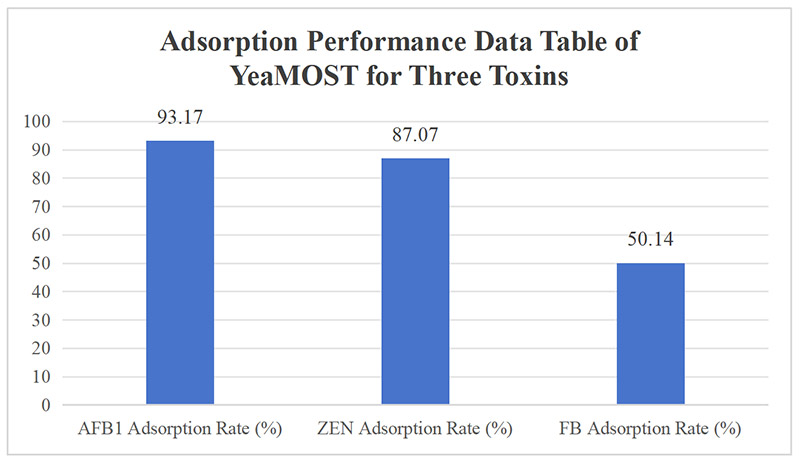
Data indicate that after modification, the adsorption rate for aflatoxin B1 increased significantly to 93.17%, while the adsorption rate for zearalenone remained stable (approximately 87%). The adsorption rate for fumonisins also improved.
Application Strategies
For practical application, YeaMOS T is recommended at inclusion rates of 0.5–1 kg/t in slightly contaminated livestock feed and 1–2 kg/t under severe contamination. In dairy cows, the suggested dosage ranges from 10–15 g/head/day for mild contamination to 20–30 g/head/day for severe cases, while in total mixed ration (TMR) diets, 10 kg/t is recommended. When used as a functional component in compound mycotoxin binders, YeaMOS T should be formulated at 40–60% (alongside high-purity montmorillonite) for aflatoxin B1 control, 80–90% (with vitamin E and selenium yeast) for zearalenone, and 60–80% (with Bacillus spp.) for deoxynivalenol, corresponding to total binder inclusion rates of 2–4 kg/t, 1–2 kg/t, and 2–3 kg/t, respectively.
Technical Advantages and Conclusion
High Adsorption Efficiency for Aflatoxin: Adsorption rate increased to over 93%, significantly outperforming conventional yeast cell walls.Broad-Spectrum Activity: Effective against zearalenone, fumonisins, and other mycotoxins.High Safety Profile: Does not adsorb nutrients or increase feed ash content, suitable for high-quality feed applications.Mature Manufacturing Process: Pilot-scale production completed with good batch-to-batch consistency.Flexible Application: Can be used as a core ingredient in mycotoxin binders or added directly to feed.
With targeted structural optimization and activation technology, modified yeast cell wall YeaMOS T achieves groundbreaking improvement in aflatoxin adsorption capacity, while maintaining outstanding stability against ZEN and other mycotoxins. Featured with high efficiency, safety, broad-spectrum performance and low ash retention, YeaMOS T serves as an ideal substitute and upgraded alternative to traditional montmorillonite-based adsorbents. It is especially suitable for high-end feed production and intensive animal farming where strict ash control and maximum nutrient preservation are required.
References
[1] Ciegler, A., et al. (1996). Microbial detoxification of mycotoxins. Journal of Food Protection, 59(3), 304–310.
[2] Yiannikouris, A., et al. (2006). Molecular interactions between a yeast cell wall and zearalenone. Journal of Agricultural and Food Chemistry, 54(15), 5331–5339.
[3] Pereyra, C. M., et al. (2012). Aflatoxin B1 adsorption by yeast cell wall. Food Additives & Contaminants: Part A, 29(9), 1425–1432.
[4] Joannissac, E., et al. (2011). Variability of yeast cell wall adsorption capacity based on source and processing. Animal Feed Science and Technology, 168(3–4), 223–231.
[5] Swamy, H. V. L. N., et al. (2003). Deoxynivalenol adsorption by yeast cell wall. Poultry Science, 82(6), 988–994.
About Angel Animal Nutrition
Angel Animal Nutrition focuses on providing professional yeast solutions for animal nutrition, caring for animal health, reducing antibiotic use, and promoting the sustainable development of the livestock industry. Together with our partners, we are always in action, working hand in hand to create a better future.
About Angel
Angel Yeast Company is a high-tech listed company specializing in yeast and biotech. Product business covers Yeast and Baking, Yeast Extract-Savoury, Nutrition & Health and Biotechnology fields. It is one of the world's leading companies in the yeast industry. Angel has 12 holding subsidiaries and provides products and services for more than 150 countries and regions.
Press Contact
ANGEL YEAST CO.,LTD
Address: 168 Chengdong Avenue, Yichang, Hubei 443003, P. R.China
Tel:+86-717-6369520, 6369558
Email: aie@angelyeast.com